The moments following a vehicular collision are often marked by disorientation, stress, and a flood of logistical concerns. Standing on the shoulder of a highway or in a busy intersection, vehicle owners naturally focus on the visible exterior damage: a crumpled plastic bumper, a creased hood, a cracked headlamp assembly, or a shattered side mirror. It is easy to assume that repairing the car is simply a cosmetic matter of pulling dents, replacing exterior body panels, and applying a fresh coat of clear coat.
In modern automotive engineering, however, surface appearance tells only a small fraction of the story. Today’s vehicles are intricate structural and electronic ecosystems designed to sacrifice themselves to protect human occupants. Beneath the exterior sheet metal and composite plastic covers lies a complex skeleton engineered from mild steels, advanced high-strength steels, ultra-high-strength boron alloys, and structural aluminum castings. Alongside these metallurgy choices, dozens of microprocessors, multiplexed data networks, and radar sensors operate behind the scenes to control occupant restraints and automated safety interventions.
When an impact occurs, kinetic energy travels through the vehicle along engineered load paths. Energy transfers through subframe mounts, across suspension links, down longitudinal frame rails, and through the passenger safety cell. Consequently, a superficial parking lot appraisal cannot determine whether a vehicle is structurally sound or mechanically roadworthy. Professional collision technicians approach post-impact analysis not as a quick visual inspection, but as a systematic forensic investigation. Understanding this rigorous diagnostic process allows vehicle owners to make informed choices, protect their financial interests, and verify that their vehicle is restored to manufacturer safety standards.
Securing Safe Transport and Documenting Initial Scene Damage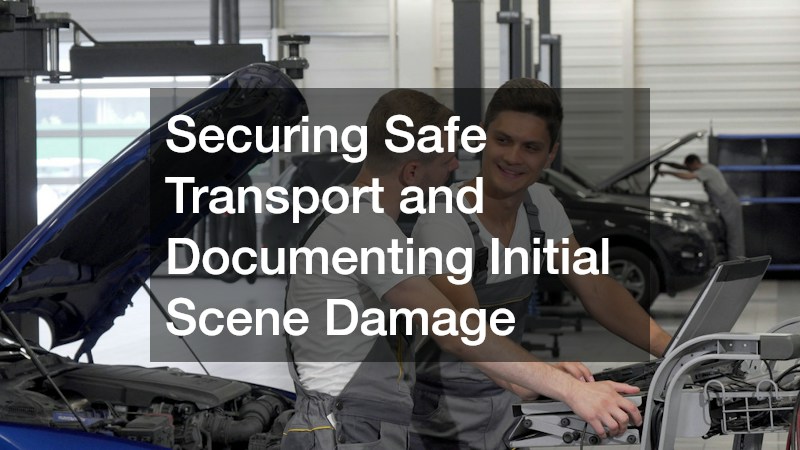
The diagnostic journey begins at the physical impact site, long before a car reaches an inspection bay. In the immediate aftermath of a collision, owners frequently wonder whether their vehicle remains safe to drive home or to a local repair facility. While an engine may start and the car may roll forward, driving a crash-damaged vehicle is exceptionally hazardous. Undetected kinetic forces routinely fracture cast-aluminum steering knuckles, slice rubber brake hoses, pinch fuel lines, or dislodge transmission cooler lines that can ignite upon contacting hot catalytic converters.
Transporting a compromised vehicle demands specialized equipment to prevent secondary mechanical and structural damage. Attempting to drag an all-wheel-drive crossover, a modern hybrid, or a dual-motor electric vehicle using traditional wheel-lift dollies can destroy differential gears, burn out internal transfer cases, and ruin electronic parking brake actuators. Dispatching a professional car towing flatbed service ensures that the vehicle is pulled onto an inclined aluminum bed using non-marring synthetic axle straps rather than steel chains hooked blindly around delicate aluminum lower control arms.
Once the vehicle arrives at the repair facility, technicians begin an intake protocol that preserves physical and electronic evidence. The intake team documents the exact environmental conditions, roadway surfaces, and impact vectors associated with the auto accident. Understanding whether the vehicle sustained an oblique corner strike, an underride collision beneath a commercial trailer, or a direct lateral impact into a concrete curb gives mechanics an immediate roadmap of which underlying sub-assemblies absorbed the highest mechanical stress:
- Photographing primary impact contact zones, noting paint transfer, plastic deformation, and intrusion depth into exterior sheet metal.
- Logging all active fluid leaks, distinguishing between engine oil, automatic transmission fluid, engine coolant, synthetic power steering fluid, and refrigerant oils.
This rigorous intake documentation establishes a baseline chain of custody. It ensures that every dent, scraped subframe rail, and damaged electrical connector is cataloged before technicians begin disassembly, providing objective documentation for insurance adjusters and vehicle owners alike.
Interrogating Vehicle Computers and Running Pre-Repair Diagnostic Scans
Modern automobiles are rolling supercomputers governed by dozens of interconnected Electronic Control Units (ECUs) communicating across Controller Area Network (CAN-bus), Local Interconnect Network (LIN-bus), and automotive Ethernet networks. In a significant collision, physical deformation is almost always mirrored by electronic faults. Before a technician turns a single wrench or unbolts a damaged fender, they must interrogate the vehicle’s digital architecture.
The mandatory first step in modern collision diagnostics is the pre-repair diagnostic scan. Technicians connect an OEM-certified scanning interface directly to the on-board diagnostics (OBD-II) port to execute a complete topology scan across every computer module in the car. This scan reveals critical diagnostic trouble codes (DTCs) that never illuminate a dashboard check-engine light or warning icon. For example, a millimeter-wave radar sensor hidden behind a front plastic grille may suffer a cracked internal mounting bracket that shifts its radar beam by two degrees. To the driver, the dashboard appears normal, yet the automatic emergency braking system can no longer calculate forward distances accurately.
Beyond reading active fault codes, specialized diagnostic technicians access the vehicle’s Supplemental Restraint System (SRS) and Airbag Control Module (ACM). Performing formal crash data retrieval allows certified analysts to download event data recorder files captured in the milliseconds before, during, and after the impact. This data stream reveals critical parameters:
- Exact vehicle velocity and throttle percentage in the five seconds leading up to the collision.
- Seat belt buckle engagement status and deployment timing of pyrotechnic seat belt pretensioners.
Reviewing crash data provides structural mechanics with an objective calculation of the kinetic forces absorbed by the vehicle cabin. If the data reveals that internal accelerometers registered forces high enough to fire seatbelt pretensioners or stage-one airbag inflators, technicians know that structural mounting points, steering columns, and seat frame brackets sustained severe shock loads.
Armed with this diagnostic data, the mechanical team builds an itemized roadmap for comprehensive mechanical auto repair. Instead of guessing which mechanical assemblies might be bent or fatigued, mechanics use electronic fault codes to target specific subsystems: electronic steering racks, adaptive cruise control radars, blind-spot monitoring sonars, and climate control blend doors that were knocked out of calibration by the impact.
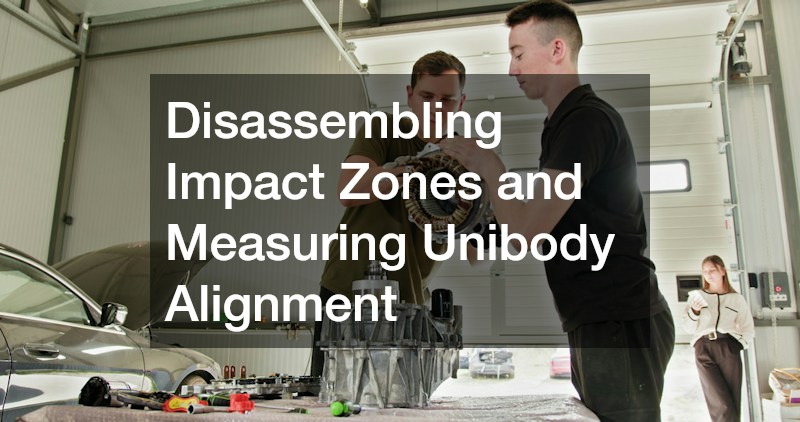
Disassembling Impact Zones and Measuring Unibody Alignment
The most dangerous assumption a vehicle owner or insurance appraiser can make is relying on a visual estimate conducted while a damaged car remains fully assembled. Outer vehicle fascias are constructed from flexible thermoplastic polyolefins designed to deform on impact and pop back into their original shape. A plastic bumper cover may display only minor scuffs and chipped paint, while the heavy extruded aluminum bumper reinforcement bar, stamped steel crash cans, and longitudinal frame rails underneath are completely crushed.
Accurate diagnosis requires a process known in the industry as blueprinting or complete mechanical teardown. Certified technicians systematically strip away damaged body panels, headlamp assemblies, fender liners, wheel arches, and acoustic shields until the raw, underlying structural metal is exposed to direct inspection. Every removed component is cataloged, labeled, and assessed to determine whether it can be safely reconditioned or must be discarded in favor of original equipment manufacturer (OEM) replacements.
Once the underlying chassis is exposed, the vehicle is anchored to a heavy structural frame bench for comprehensive auto body collision repair. Today’s unibody vehicles rely on exacting dimensional tolerances where a deviation of just two or three millimeters in a front apron rail can misalign suspension geometry, bind steering linkages, and cause headlamps to point askew:
- Mounting the vehicle to high-rigidity clamping pinch-welds to establish a fixed, level reference plane across the center section of the chassis.
- Comparing live spatial coordinates against factory OEM digital dimensional blueprints down to the individual millimeter.
While structural technicians measure and align the unibody skeleton, paint and refinishing specialists examine adjacent sheet metal panels for indirect paint damage. When a front frame rail shifts sideways during a crash, it pushes against the inner fender apron, which buckles the outer fender and pinches the front door edge.
Identifying these hidden pressure fractures is essential for long-term auto body paint repair. The refinishing team inspects underlying e-coat primers, checks zinc galvanizing coatings for micro-cracking, and calculates the paint blending zones required across adjacent panels. Documenting these requirements early ensures that replacement panels receive corrosion protection matching factory specifications and that multilayer metallic and pearl finishes match the aging vehicle’s exterior panels.
Verifying Drivetrain Clearance and Auditing Secondary Safety Enclosures

A violent roadway impact does not stop at the vehicle’s outer sheet metal. Kinetic shock waves travel through the powertrain, suspension knuckles, and steering gear. Even in moderate low-speed accidents, the sudden deceleration can cause the heavy mass of the engine and transmission to snap their hydraulic rubber isolators, shifting the entire drivetrain assembly inches out of alignment inside the engine bay.
Mechanics must inspect all drivetrain mounts, subframe bushings, and axle half-shafts. If an engine shifts on its cradle, it places extreme shear stress on constant velocity (CV) joints, bends intermediate drive axles, and crimps aluminum air conditioning hardlines. Technicians use dial indicators to measure rotational runout on wheel hubs and drive axles, verifying that curb impacts have not warped rotating assemblies or damaged internal differential bearings.
The vehicle’s primary deceleration systems also demand rigorous forensic inspection. During an impact, the driver’s foot is typically planted hard on the brake pedal, introducing extreme hydraulic line pressure at the precise moment the wheels strike an obstacle or come to a sudden halt.
A thorough post-collision inspection requires dedicated mechanical brake repair procedures:
- Removing all four road wheels to inspect cast-iron and aluminum brake calipers for hairline fractures, broken bleeder screws, and distorted slide pins.
- Checking brake rotor runout and thickness variation using a digital micrometer to confirm that severe curb impacts have not warped the braking friction surface.
Simultaneously, mechanics inspect the vehicle’s safety glass enclosures. Many drivers view a windshield simply as a clear barrier against wind, rain, and road debris. In modern automotive safety design, however, the windshield is a critical structural load-bearing member of the vehicle body. In a rollover event, the bonded front windshield provides up to thirty percent of the cabin’s structural roof-crush resistance, preventing the roof pillars from collapsing inward on passengers. Furthermore, when the passenger-side front airbag deploys, it fires upward at high velocity, bouncing off the inside of the windshield glass to cushion the passenger. If the glass is cracked or improperly bonded, the force of the deploying airbag can blow the windshield out of its frame, leaving the occupant unprotected.
When a collision causes stress fractures or delamination along the glass perimeter, executing a certified auto glass replacement is mandatory. Technicians must strip the windshield down to the bare pinch-weld, prime the metal frame to prevent hidden corrosion, and install OEM-grade acoustic laminated glass using high-modulus, non-conductive polyurethane adhesives. Following glass installation, technicians recalibrate the forward-facing Advanced Driver Assistance System (ADAS) optical cameras mounted directly behind the rearview mirror, ensuring that lane-keep assist and automated pedestrian detection systems interpret roadway markings accurately.
Rebuilding Structural Upgrades and Managing Repair Authorizations

Once the teardown is complete, the 3D frame measurements are mapped, the mechanical systems are inspected, and the electronic fault sweeps are finalized, the repair facility enters the authorization and blueprinting phase. In traditional auto body shops, this stage was often handled reactively: a mechanic would begin repairs, discover broken parts along the way, and submit repeated delay-causing requests to the vehicle owner and insurance provider.
Modern repair centers avoid these delays by creating a comprehensive initial repair blueprint. Mechanics document every broken plastic tab, pinched wiring harness, and bent suspension link with high-resolution digital photographs, manufacturer technical service bulletins, and precision measurement readouts. This documentation supports the insurance supplement process, proving to claims adjusters that underlying structural pulls and mechanical component replacements are engineering requirements rather than optional recommendations.
Navigating this administrative process helps vehicle owners understand their policy rights. Policyholders carrying quality, affordable auto insurance are entitled to have their damaged property restored to its pre-loss condition in terms of safety, performance, and appearance. When an insurer attempts to mandate the use of generic, non-certified salvage suspension components or aftermarket structural bumper bars, the repair shop’s diagnostic data acts as an objective defense:
- Presenting printed 3D unibody coordinate sheets proving that structural rails require authorized frame-bench pulling times.
- Demonstrating through factory repair procedures why high-strength boron B-pillars cannot be straightened and must be ordered directly from the OEM manufacturer.
For automotive enthusiasts and owners of personalized vehicles, the post-collision reconstruction phase also offers an opportunity to coordinate specialty work. If a collision damages custom front grilles, wide-body fiberglass arches, lowered coilover suspensions, or sport exhaust systems, the owner must coordinate with mechanics who understand aftermarket auto customization.
Rather than replacing damaged parts with stock factory equipment, specialized technicians can source upgraded performance components, reinforced skid plates, or custom aerodynamic body kits that integrate smoothly with the vehicle’s restored unibody framework. Rebuilding a customized vehicle requires verifying that aftermarket parts do not obstruct radar brackets, ultrasonic parking sensors, or factory cooling airflow ducts.
By understanding how professional collision technicians dissect an impact, uncover hidden damage, and verify mechanical integrity, you take control of your vehicle’s recovery. You gain the confidence to ask the right technical questions, insist on OEM-compliant repair procedures, and ensure your insurance claims process covers every necessary safety step. When you finally turn the key and drive away from the repair facility, you can rest assured that your car is not just visually restored, but structurally sound, mechanically dependable, and ready to protect you and your passengers for thousands of miles to come.